A Rational and Evidenced Based Response Regarding Sleep Apnea and Care
No doubt this is a very complex subject, but it is also one where the clinical model matters as much as the individual treatment.
The central point is that sleep-disordered breathing should not be approached as simply “find an AHI and give the patient a CPAP or an appliance.” It is a chronic, heterogeneous medical disorder in which the type of apnea, anatomy, physiology, comorbidities, treatment preference, adherence, and the longitudinal response all matter. Also, the epidemiology below has been updated because some of the older “30 million/80% undiagnosed” estimates are now substantially underestimating the apparent problem in the U.S.
CLICK THE LINE ITEMS BELOW TO NAVIGATE TO SPECIFIC SUBJECT MATERS *** CLICK HERE TO DOWNLOAD THIS IN A PDF FORMAT TO YOUR COMPUTER
1. What are the three types of sleep apnea and how are each treated
3. What are the methods of obtaining a diagnosis
5. Describe the following treatment options along with the advantages and disadvantages of each
a. CPAP (auto-PAP, BiPap, ASV devices)
b. Mandibular Advancement Devices more commonly called Oral Appliance Therapy
c. Various surgical procedures including the Inspire Implant system and weight loss surgeries
d. Weight loss itself as related to the GLP-1 medications
a. Open and transparent Medical-Dental collaboration
b. Why physicians that are credentialed-boarded in sleep are critical with respect to outcome
takes place and what exactly needs to be monitored and tracked
a. Naturally and of course a practice that is limited to sleep

1. The three types of sleep apnea
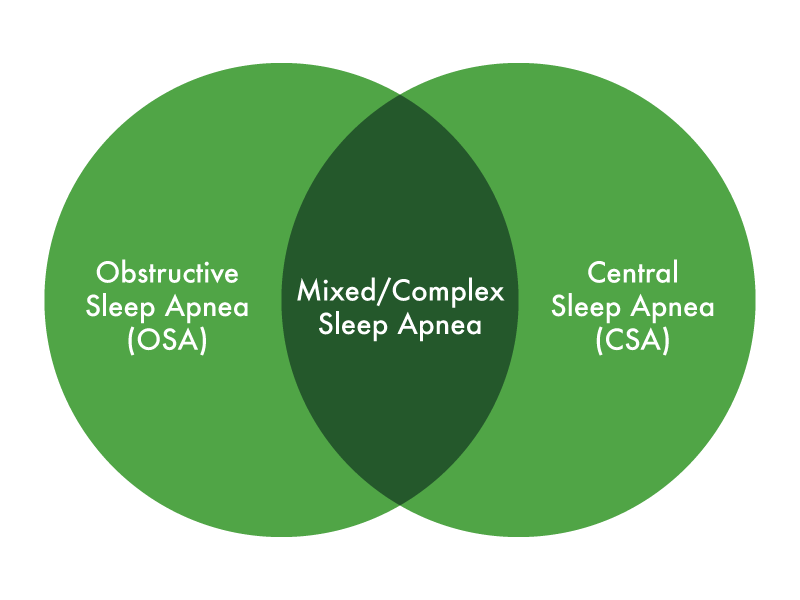
There are two fundamental physiologic types of sleep apnea:
- Obstructive sleep apnea (OSA)
- Central sleep apnea (CSA)
- Treatment-emergent central sleep apnea (TECSA) — sometimes called “complex sleep apnea”
In addition to those that have a combination of OSA and CSA, a third clinically important category is TECSA and it is important to distinguish these because the treatments are not interchangeable.
A. Obstructive Sleep Apnea — OSA
What happens?
The patient continues trying to breathe, but the upper airway collapses.
The basic sequence is:
Reduced pharyngeal stability → airway narrowing/collapse → continued respiratory effort → reduced/absent airflow → oxygen desaturation/arousal → airway reopening
The patient may have:
- loud snoring
- choking/gasping
- witnessed apneas
- fragmented sleep
- excessive daytime sleepiness
- morning headaches
- nocturia
- hypertension
- atrial fibrillation
- impaired concentration
- mood changes
But importantly, some patients have very few subjective symptoms.
Major mechanisms
OSA is influenced by:
- craniofacial anatomy
- tongue position
- mandibular position
- soft palate
- lateral pharyngeal wall collapsibility
- obesity/adipose tissue
- nasal resistance
- sleep position
- age
- menopause
- alcohol/sedatives
- neuromuscular control of the airway
- ventilatory control/“loop gain”
Treatment
Depending upon severity and phenotype:
- CPAP/APAP
- oral appliance therapy
- weight reduction
- positional therapy
- nasal/upper-airway treatment
- selected upper-airway surgery
- maxillomandibular advancement
- hypoglossal nerve stimulation/Inspire
- bariatric surgery in appropriate patients
- pharmacologic weight-loss therapy
- combination therapy
B. Central Sleep Apnea — CSA
CSA is fundamentally different.
The airway may be open, but the brain's respiratory control system temporarily fails to generate adequate respiratory effort.
Therefore:
No respiratory effort → no airflow
rather than:
Respiratory effort → obstructed airflow
Causes include:
- heart failure
- opioid medications
- high altitude
- certain neurologic disorders
- treatment-emergent CSA
- idiopathic/primary CSA
- certain medications/substances
The new 2025 AASM CSA guideline specifically recognizes several etiologic categories and recommends that treatment be tailored to the cause.
Treatment
Depending upon cause:
- treating the underlying disease
- CPAP in selected patients
- BPAP with a backup rate
- ASV
- supplemental oxygen in selected CSA populations
- medications such as acetazolamide in selected circumstances
- phrenic nerve stimulation in selected patients
Importantly, a mandibular advancement device is not a treatment for primary central apnea because the fundamental problem is not upper-airway obstruction.
C. Treatment-Emergent Central Sleep Apnea
This is particularly important in PAP management.
A patient begins with predominantly obstructive apnea.
PAP opens the airway.
But after obstruction is removed, the patient develops repeated central apneas.
This can occur because of alterations in:
- CO₂ reserve
- ventilatory control
- loop gain
- arousal threshold
- respiratory stability
Some cases resolve with continued CPAP therapy. Others persist.
Persistent clinically important treatment-emergent CSA may require:
- optimization of CPAP
- addressing medications/opioids
- BPAP with backup rate in selected patients
- ASV in appropriate patients
The current AASM guideline supports ASV for several CSA etiologies, including treatment-emergent CSA, with special caution and experienced-center management in patients with heart failure with reduced ejection fraction.
This is one reason why simply saying “the patient failed CPAP” is inadequate. You need to know why the patient failed.
2. How many people have sleep apnea?
This is where the magnitude of the problem becomes striking.
Worldwide
A major Lancet Respiratory Medicine analysis estimated:
- approximately 936 million adults age 30–69 have OSA with AHI ≥5
- approximately 425 million have moderate-to-severe OSA with AHI ≥15.
That study is older, but it remains one of the most widely cited global prevalence estimates.
United States
More recent modeling suggests the burden is substantially larger than the traditional “25–30 million” figure.
A 2025 analysis estimated approximately:
83.7 million U.S. adults with OSA
or approximately 32.4% of adults ≥20 years old.
Estimated prevalence was:
- 39.1% in men
- 26.0% in women
with approximately:
- 52% mild
- 30% moderate
- 18% severe.
Another 2025 analysis estimated approximately 80.6 million U.S. adults with OSA.
The exact number varies because prevalence depends heavily on:
- AHI definition
- oxygen-desaturation criteria
- age
- sex
- obesity prevalence
- whether symptoms are required
- study methodology
But the overall conclusion is clear:
OSA is vastly more prevalent than the number of diagnosed patients suggests.
3. How many are undiagnosed and untreated?
A recent U.S. estimate presented at SLEEP 2025 estimated:
- up to 85.6 million adults with OSA
- approximately 68.5 million (80%) undiagnosed
- approximately 17.1 million diagnosed
- approximately 4.5 million of those diagnosed (26%) untreated
And there is another major problem:
Among people who initiate PAP, approximately 63% discontinued treatment or failed Medicare adherence criteria in the analysis.
So the problem isn't simply:
“How many people have OSA?”
It is:
How many have it → how many are diagnosed → how many start therapy → how many actually use it → how many achieve adequate physiologic control?
That is a much more clinically meaningful continuum.
4. How is sleep apnea diagnosed?
There are two principal objective diagnostic approaches.
A. Home Sleep Apnea Testing — HSAT
A properly selected patient can undergo a home sleep apnea test.
Typical measurements may include:
- airflow
- respiratory effort
- oxygen saturation
- pulse
- snoring
- body position
Advantages:
- convenient
- inexpensive relative to PSG
- occurs in the patient's normal environment
- easier access
- can dramatically increase diagnostic capacity
The limitation is that HSAT generally does not measure sleep directly with EEG, so respiratory indices are often calculated using recording time rather than true sleep time.
Therefore, HSAT can underestimate severity, particularly when the patient spends substantial time awake.
AASM resources emphasize that HSAT is appropriate primarily for uncomplicated adults with suspected OSA, whereas polysomnography remains necessary in many more complicated situations.
B. In-Laboratory Polysomnography — PSG
PSG remains the most comprehensive diagnostic study.
It can measure:
- EEG
- EOG
- chin EMG
- leg EMG
- ECG
- airflow
- respiratory effort
- oxygen saturation
- body position
- snoring
It can therefore determine:
- actual sleep time
- sleep stages
- arousals
- REM vs NREM effects
- positional effects
- central vs obstructive events
- periodic breathing
- limb movements
- sleep architecture
PSG is particularly important when there is:
- suspected central apnea
- significant cardiopulmonary disease
- neuromuscular disease
- unexplained hypoxemia
- significant insomnia
- parasomnia
- narcolepsy concern
- inconclusive HSAT
- unusual or complex sleep-disordered breathing
5. Why isn’t one night always enough
This is particularly relevant to mild OSA.
OSA can vary substantially between nights because of:
- sleep position
- REM percentage
- alcohol
- nasal congestion
- weight
- medications
- sleep deprivation
- altitude
- illness
Consequently, a single negative or borderline night does not always establish that clinically important OSA is absent.
This is one reason a multi-night home monitoring strategy can be particularly valuable in borderline cases.
6. What happens if OSA remains untreated?
The danger isn't simply “the patient is tired.”
The fundamental pathophysiology is:
airway obstruction → hypoxia → reoxygenation → sympathetic activation → blood-pressure surges → intrathoracic pressure swings → endothelial stress → inflammation/metabolic dysfunction → sleep fragmentation
OSA is strongly associated with:
Cardiovascular disease
- hypertension
- resistant hypertension
- coronary artery disease
- myocardial infarction
- heart failure
- atrial fibrillation
- other arrhythmias
- pulmonary hypertension
- stroke
- cardiovascular mortality
The American Heart Association notes that OSA prevalence may reach 40–80% among patients with hypertension, heart failure, coronary artery disease, pulmonary hypertension, atrial fibrillation and stroke.
Metabolic disease
- insulin resistance
- type 2 diabetes
- metabolic syndrome
- obesity
- dyslipidemia
- fatty liver disease
Neurologic/cognitive
- excessive daytime sleepiness
- impaired concentration
- memory impairment
- reduced executive function
- mood disturbance
- depression/anxiety associations
Safety
Perhaps one of the most immediate consequences is:
increased motor-vehicle and occupational accident risk from sleepiness and impaired vigilance.
Reviews of OSA complications include cardiovascular, metabolic, neuropsychiatric and accident-related consequences.
7. Treatment options
A. CPAP
How it works
CPAP produces positive airway pressure that acts as a pneumatic splint to prevent upper-airway collapse.
It is exceptionally effective at reducing:
- apneas
- hypopneas
- oxygen desaturation
- arousals
AASM recommends PAP therapy for OSA and recommends either CPAP or APAP for ongoing routine treatment.
Advantages
- highly effective
- works across a broad spectrum of OSA severity
- particularly powerful in moderate/severe disease
- excellent physiologic control
- can be objectively monitored
- rapidly reduces respiratory events
Disadvantages
- mask discomfort
- nasal congestion
- dry mouth
- leaks
- pressure intolerance
- claustrophobia
- aerophagia
- noise
- inconvenience
- adherence problems
And this is the key distinction:
CPAP efficacy is excellent; CPAP effectiveness depends upon actual use.
8. APAP — Auto-PAP
APAP automatically changes pressure according to detected respiratory obstruction.
Advantages
- adapts to changing pressure requirements
- may improve comfort
- can often be initiated without laboratory titration in uncomplicated patients
- provides substantial data for longitudinal monitoring
AASM specifically supports either home APAP initiation or laboratory titration in appropriate adults without significant comorbidities.
Disadvantages
- pressure changes can disturb some patients
- not appropriate for every phenotype
- can be problematic in certain complex respiratory disorders
- requires interpretation of downloaded data
9. BiPAP/BPAP
BPAP provides:
- higher inspiratory pressure
- lower expiratory pressure
It is particularly useful when ventilatory assistance or pressure support is needed.
However, BPAP is not simply “better CPAP.”
For routine uncomplicated OSA, AASM suggests CPAP/APAP rather than BPAP.
For central apnea, the newer AASM guideline distinguishes BPAP with a backup rate from BPAP without one. It recommends against BPAP without a backup rate for several CSA etiologies because excessive pressure support can actually promote central apnea.
10. ASV — Adaptive Servo-Ventilation
ASV is a sophisticated form of PAP designed to stabilize ventilation.
It continually responds to the patient's breathing pattern and adjusts pressure support.
It is particularly relevant to:
- treatment-emergent CSA
- certain forms of primary CSA
- medication/opioid-associated CSA
- selected heart-failure-associated CSA
The current AASM guideline supports ASV in several CSA categories but emphasizes special caution and experienced-center management in patients with HFrEF.
Advantages
- highly sophisticated control of unstable breathing
- excellent for selected central-apnea phenotypes
- can address periodic breathing
Disadvantages
- expensive
- more complex
- requires appropriate diagnosis
- not appropriate for every patient
- heart-failure phenotype must be carefully evaluated
11. Mandibular Advancement Devices / Oral Appliance Therapy
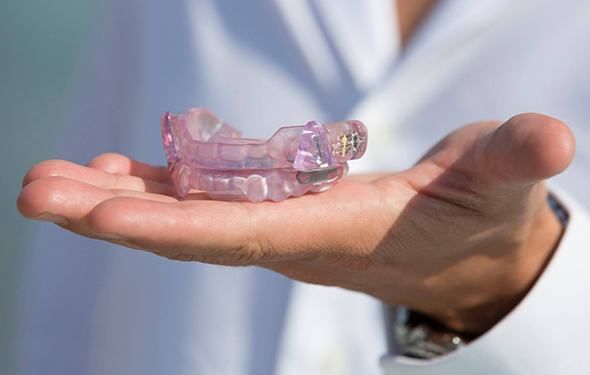
For appropriately selected OSA patients, a custom, titratable mandibular advancement device moves the mandible forward, increasing upper-airway stability.
The AASM/AADSM guideline recommends oral appliance therapy for adults with OSA who are intolerant of CPAP or prefer an alternative, and specifically recommends a custom, titratable appliance rather than a non-custom device.
Advantages
- small
- silent
- portable
- no mask
- no hose
- no electricity
- generally easy to travel with
- often better accepted
- frequently high nightly use
- useful for positional/mild-to-moderate OSA
- useful for CPAP-intolerant patients
- can be combined with PAP in selected cases
This is where an important clinical concept arises:
Efficacy versus effectiveness
CPAP generally reduces AHI more.
But if:
CPAP reduces AHI by 90% but is worn 4 hours
while
MAD reduces AHI by 60% but is worn 7 hours
the real-world therapeutic comparison becomes much more interesting.
Clinical trials have repeatedly demonstrated that CPAP generally produces greater reduction in respiratory events while MAD adherence can be greater.
Recent evidence also suggests that MAD therapy can provide clinically meaningful blood-pressure effects, including in patients with hypertension and elevated cardiovascular risk.
Disadvantages
- may not completely eliminate OSA
- titration required
- dental discomfort
- tooth movement
- occlusal changes
- TMJ symptoms in susceptible patients
- salivation/dry mouth
- limited suitability with inadequate dentition
- requires ongoing dental surveillance
- objective follow-up testing is essential
The AASM/AADSM guideline specifically recommends dentist follow-up for dental side effects/occlusal changes and follow-up sleep testing to confirm efficacy.
12. Surgery
Surgery should not be viewed as one treatment.
It is a family of treatments directed at different anatomic problems.
Examples include:
- tonsillectomy
- adenoidectomy
- nasal surgery
- turbinate surgery
- palatal procedures
- UPPP
- tongue-base procedures
- epiglottic procedures
- maxillomandibular advancement
- hypoglossal nerve stimulation
- bariatric surgery
AASM recommends discussion of surgical consultation for appropriately selected adults who are intolerant or unaccepting of PAP and emphasizes collaborative care between sleep clinicians and surgeons.
13. Inspire — hypoglossal nerve stimulation
Inspire is fundamentally different from PAP.
It electrically stimulates the hypoglossal nerve during inspiration, helping maintain tongue-base airway patency.
Current FDA labeling has expanded the AHI range up to 100, with BMI labeling/warnings extending to 40.
It is intended for appropriately selected patients with:
- moderate/severe OSA
- inability to use or benefit adequately from PAP
- appropriate upper-airway anatomy
Complete concentric collapse at the soft palate is an important exclusion, and significant central/mixed apnea is also a contraindication.
Advantages
- no mask
- no external PAP equipment during sleep
- excellent adherence in many patients
- physiological stimulation rather than pneumatic splinting
Disadvantages
- surgery required
- implanted device
- battery replacement eventually
- surgical/device complications
- cost
- patient selection limitations
- not appropriate for central apnea
- requires ongoing follow-up
14. Bariatric surgery
For patients with:
- obesity
- significant OSA
- particularly BMI ≥35
bariatric surgery can produce substantial weight reduction and frequently improves OSA.
AASM specifically recommends discussion of bariatric surgical referral for adults with OSA and BMI ≥35 who are intolerant or unaccepting of PAP.
But:
Improvement is not synonymous with cure.
A patient should be retested after substantial weight loss rather than simply assuming the OSA has disappeared.
15. Weight loss and GLP-1/GIP medications
This is one of the most important recent changes in OSA management.
The FDA approved tirzepatide (Zepbound) in December 2024 for moderate-to-severe OSA in adults with obesity, combined with reduced-calorie diet and increased physical activity. It became the first FDA-approved medication specifically for OSA.
The mechanism is primarily:
reduced appetite → weight loss → reduced upper-airway adiposity/collapsibility → improved OSA
This does not mean GLP-1/GIP medication replaces PAP or oral appliance therapy in every patient.
It should instead be viewed as another component of a potentially comprehensive OSA treatment strategy.
For example:
Weight loss + MAD
or
Weight loss + CPAP
or
Weight loss + positional therapy
may be considerably more powerful than relying on one intervention alone.
16. Positional therapy
Some patients have dramatically worse OSA when supine.
For these patients:
back sleeping → more airway collapse
while:
lateral sleeping → less obstruction
Positional therapy can therefore be highly useful when the patient's OSA is genuinely positional.
Advantages
- inexpensive
- noninvasive
- no mask
- no medication
- can be combined with other treatments
Disadvantages
- only works if OSA is positional
- patients can adapt to devices
- patients may return to supine sleep
- does not address non-positional OSA
17. Supplemental nocturnal oxygen
This requires considerable caution.
Oxygen can improve:
- oxygen saturation
- hypoxemic burden
But oxygen does not necessarily eliminate the airway obstruction.
A patient can continue having:
- apneas
- hypopneas
- arousals
- intrathoracic pressure swings
- sympathetic activation
while the oxygen saturation looks better.
Therefore:
Oxygen can improve the oximeter while the underlying obstructive disease continues.
It should generally not be considered a substitute for PAP or an effective oral appliance in uncomplicated OSA.
It has much more specific roles in selected patients with:
- persistent hypoxemia
- certain cardiopulmonary diseases
- selected CSA phenotypes
- high-altitude CSA
The 2025 AASM CSA guideline, for example, conditionally supports low-flow oxygen for CSA associated with high altitude.
This is especially important when considering combination therapy such as:
MAD + oxygen
because the MAD addresses the obstruction while oxygen addresses hypoxemia—but the combination still needs objective follow-up.
18. Why medical-dental collaboration is so important
This may be one of the most important principles in modern dental sleep medicine.
OSA is a medical disease involving an anatomic structure that happens to be within the dentist's area of expertise.
The dentist understands:
- teeth
- occlusion
- mandible
- TMJ
- craniofacial anatomy
- oral appliance mechanics
The sleep physician understands:
- diagnosis
- respiratory physiology
- cardiovascular consequences
- central apnea
- PAP
- medications
- comorbidities
- differential diagnosis
The best model combines those skill sets.
The AASM/AADSM guideline explicitly emphasizes collaboration between sleep physicians and dentists.
19. Why a board-certified sleep physician matters
This is not simply about having an MD.
Sleep medicine is a multidisciplinary specialty requiring understanding of:
- respiratory physiology
- cardiology
- neurology
- pulmonology
- psychiatry
- sleep architecture
- PAP
- central apnea
- medications
- complex sleep disorders
A board-certified sleep physician is particularly valuable when:
- the diagnosis is uncertain
- central apnea is present
- significant cardiovascular disease exists
- opioids are involved
- PAP has failed
- ASV is being considered
- oxygen is being considered
- surgery is being considered
- there is unexplained residual sleepiness
In other words:
The more complicated the patient, the more important specialized sleep-medicine oversight becomes.
20. Chronic-care monitoring
I strongly agree with your premise here.
OSA should be treated as a chronic disease requiring longitudinal management, not:
“Here is your CPAP.”
or
“Here is your appliance. See you next year.”
The AASM PAP guideline specifically calls for adequate follow-up after PAP initiation and during treatment.
For oral appliances, AASM/AADSM specifically recommend periodic physician/dentist follow-up and objective sleep testing to confirm treatment efficacy.
21. What should actually be monitored?
I would divide it into six domains.
1. Disease control
Track:
- AHI
- ODI
- oxygen nadir
- time below 90%
- hypoxic burden when available
- central apnea index
- obstructive apnea index
- RDI/RERAs when available
- positional dependence
- REM dependence
- heart-rate response
2. Treatment adherence
For PAP:
- nights used
- hours/night
- percentage ≥4 hours
- percentage ≥6 hours
- leak
- pressure
- residual AHI
- central events
- mask problems
For OAT:
- nightly use
- advancement
- symptoms
- appliance integrity
- dental changes
- occlusal changes
- TMJ symptoms
3. Patient outcomes
Track:
- Epworth Sleepiness Scale
- fatigue
- morning headache
- cognition
- mood
- quality of life
- snoring
- bed-partner observations
4. Cardiometabolic outcomes
Track or coordinate with the medical team regarding:
- blood pressure
- weight
- BMI
- glucose
- HbA1c
- lipids
- atrial fibrillation
- cardiovascular disease
- medication requirements
5. Oxygenation
Particularly:
- overnight SpO₂
- ODI
- oxygen nadir
- cumulative hypoxemia
- persistent hypoxemia despite control of obstruction
6. Anatomy
For oral-appliance patients:
- range of motion
- TMJ symptoms
- occlusion
- morning bite
- tooth mobility
- periodontal status
- appliance fit
- advancement
This is where a dentist with substantial TMD experience becomes extremely valuable.
22. Why a dentist specifically trained in dental sleep medicine matters
There is an enormous difference between:
a dentist who owns an oral appliance
and
a dentist who understands sleep medicine and manages oral-appliance therapy as part of a medical treatment plan.
The latter needs to understand:
- sleep studies
- AHI
- RDI
- ODI
- oxygen burden
- central apnea
- PAP
- ASV
- positional OSA
- hypoxemia
- cardiovascular risk
- oral-appliance mechanics
- mandibular advancement
- titration
- treatment failure
- combination therapy
- follow-up testing
The AASM/AADSM guideline specifically calls for qualified dentists to use custom titratable appliances and monitor dental side effects and occlusal changes.
23. Why a practice focused on sleep can be advantageous
A dentist who treats 5 oral-appliance patients per year has a fundamentally different experience from someone who has treated hundreds or thousands.
A sleep-focused practice develops experience with:
- different appliances
- different mandibular advancement requirements
- titration
- difficult patients
- CPAP failures
- combination therapy
- treatment failures
- appliance side effects
- follow-up sleep testing
- interpretation of longitudinal data
There is also an important systems advantage:
The practice develops a treatment pathway rather than simply a treatment.
Screen → diagnose → phenotype → select therapy → titrate → objectively verify → monitor → adjust
That is a fundamentally better model.
24. Why TMD, craniofacial pain and head/neck experience matters
This is particularly important for oral appliance therapy.
You are deliberately changing mandibular position night after night.
That means you are interacting with:
- TMJ loading
- muscles of mastication
- occlusion
- mandibular posture
- periodontal structures
- cervical musculature
- craniofacial biomechanics
A dentist who does not understand these systems may successfully reduce an AHI while creating a new problem:
the patient's airway is better, but their jaw hurts.
An experienced TMD clinician can recognize:
- joint instability
- disc displacement
- limited opening
- muscle pain
- parafunction
- occlusal instability
- anterior open bite
- posterior interferences
- asymmetric mandibular movement
and determine whether the patient is an appropriate appliance candidate and how aggressively the mandible should be advanced.
This is one of the major advantages of combining sleep medicine + dental sleep medicine + TMD/craniofacial expertise.
25. How I would characterize Dr. John L. Bouzis
Based on publicly available information, there are several aspects of Dr. Bouzis's background that are particularly relevant.
He graduated from Creighton University Dental School in 1975, meaning he has approximately five decades of dental experience. His practice identifies a particular focus on sleep apnea and TMJ/craniofacial conditions.
His practice reports:
- advanced training in TMD
- craniofacial pain
- headaches
- bite and jaw disorders
- sleep medicine
- OSA treatment
- CPAP/APAP
- oral appliances
- collaboration with medical providers.
His Sleep Certified profile identifies him as a Level 7 Sleep Certified Advanced Trainer.
He is also listed by the Wyoming Telehealth Network as a DDS/Sleep Medicine provider in Casper.
His practice describes its model as combining medical providers, sleep physicians, PAP/DME resources and a specifically trained dentist, rather than treating the dental appliance as an isolated dental procedure.
26. What makes that combination potentially valuable to a patient?
I would summarize the potential advantage as:
He sits at the intersection of three disciplines.
Sleep medicine
→ understanding the disease and objective testing
Dental sleep medicine
→ understanding mandibular advancement and oral-appliance treatment
TMD/craniofacial medicine
→ understanding the consequences of moving the mandible and managing the patient's jaw and occlusion
That is a particularly useful combination because the difficult patient is rarely the straightforward patient.
The difficult patient is:
“I have OSA, I hate CPAP, my jaw hurts, I have an old bite problem, I snore primarily on my back, I have hypertension, my oxygen drops at night, and my first appliance didn't work.”
That patient doesn't need someone who merely knows how to fabricate an appliance.
They need someone who can ask:
What is actually causing the patient's sleep-disordered breathing?
What phenotype does the patient have?
What treatment is most likely to work?
Can the patient tolerate it?
Is the treatment actually controlling the disease?
What is happening to the patient's jaw and occlusion?
What happens if the treatment doesn't work?
What is the next treatment?
That is the difference between
device delivery and
disease management.
27. The model I believe represents the future of sleep-apnea care
For a sophisticated practice, I would envision the pathway as:
IDENTIFY
↓
Screen for risk
↓
DIAGNOSE
HSAT / PSG
↓
PHENOTYPE
OSA vs CSA vs TECSA
Severity
Position
REM
Oxygenation
Anatomy
Comorbidities
↓
TREATMENT PLAN
CPAP/APAP
OAT
ASV/BPAP
Weight loss
GLP-1/GIP therapy
Positional therapy
Surgery/Inspire
Combination therapy
↓
OBJECTIVELY VERIFY
Repeat HSAT/PSG
Oximetry
PAP download
Appliance assessment
↓
CHRONIC MONITORING
Symptoms
AHI/RDI
ODI
oxygen burden
BP
weight
cardiovascular status
dental/TMJ status
adherence
↓
ADJUST
Advance appliance
Change appliance
Modify PAP
Add positional therapy
Address weight
Add oxygen when indicated
Refer for surgery
Consider combination therapy
↓
RETEST
Because feeling better is not the same thing as having the disease controlled, the most important conclusion and the biggest mistake in sleep apnea treatment is thinking the objective is “Get the patient in treatment.”
When in fact the objective should be: “Get the patient's sleep-disordered breathing under adequate physiologic control with a treatment the patient will actually use, while protecting and improving their overall health over the long term.” This requires diagnosis + phenotyping + treatment selection + adherence + objective verification + chronic monitoring and that is precisely why the strongest model is not ...
Physician vs Dentist or CPAP vs Oral Appliance.
but rather:
Sleep physician + appropriately trained dentist + patient + objective data + longitudinal follow-up.
The AASM's own guidance supports this collaborative approach, particularly for oral-appliance therapy and surgical alternatives. For Dr. Bouzis specifically, the publicly documented combination of long-standing dental experience, TMD/craniofacial training, dedicated sleep-apnea focus, oral-appliance experience, PAP/APAP involvement, and collaboration with medical providers gives him a distinctive clinical positioning in Casper.
Dr. John L. Bouzis / RestfulSleep
One qualification is important: It would be inappropriate to represent Dr. Bouzis as a board-certified physician in sleep medicine—he is a DDS. His role is the dental/sleep-appliance side of the multidisciplinary model, and he believes physician diagnosis/medical management should remain appropriately integrated into the patient's care. That distinction is important both clinically and legally.
This material is intended for patient education, as well as to provide an understanding and acknowledgment of the importance of physician-dentist oversite, their mutual referral relationship, and how critically important this is for patient care. It is equally important to separate the above evidence-based medical claims from any practice-specific claims when evaluating and documenting each practice’s credentials, their insurance/DME status, and/or their scope-of-practice.