SnoreLab: What it measures and how it can help identify suspected sleep apnea ...
SnoreLab is a smartphone app designed to record, measure, and analyze snoring during sleep. It helps users understand how much they snore, when it occurs, and whether it changes with factors such as alcohol consumption, sleeping position, or nasal congestion. Its main value in sleep apnea screening is indirect: it can document a potential sign of obstructive sleep apnea (OSA) and maybe a warning sign although it cannot diagnose or reliably rule out OSA on its own - but for some it's "a first step"
1. What does SnoreLab actually detect?
Snoring sounds and intensity
The phone's microphone records nighttime sounds and analyzes snoring episodes, producing a Snore Score and a timeline of snoring activity.
Patterns throughout the night
Users can review when snoring occurs and how frequently or intensely it is detected. This may help document recurring or particularly disruptive snoring.
Lifestyle associations
Users can record potential influences, such as alcohol, medications or remedies, and sleeping position, then compare their notes with recorded snoring. An important distinction: SnoreLab primarily analyzes sound, not the underlying respiratory physiology. It does not directly measure airflow, respiratory effort, oxygen saturation, or brain arousals in the way a clinical sleep study, but it can put up "Red Flags"
2. Can SnoreLab identify suspected sleep apnea?
Yes, it can help flag suspicious breathing patterns, but it cannot establish whether a person has sleep apnea. Its newer features make it more useful for this purpose than a simple snoring recorder. SnoreLab now offers three particularly relevant measurements:
BreathFlow™
An acoustic measure of breathing stability that analyzes sound patterns in 30-second segments. It classifies breathing as normal, reduced, or low, then calculates an overall nightly score.
Scores below 90% are labeled unstable by SnoreLab. This is a wellness metric, not an apnea severity rating.
Breathing Disturbance Index (BDI)
Estimates the number of suspected breathing disturbances per hour. SnoreLab labels values above 12 events/hour as elevated.
This is not the clinical apnea-hypopnea index (AHI), and the two values must not be treated as interchangeable.
Full-night audio recording
Allows users to review sounds that might suggest pauses in breathing followed by gasping, choking, or resumed snoring. These recordings can be useful during a clinical consultation.
3. What would a suspicious recording sound like?
A recurring sequence of snoring, a quiet interval, and a gasp or choking sound can raise suspicion for obstructive sleep apnea. However, silence alone does not prove an apnea, and many apneas occur without an obvious sound. This distinction is critical. Clinically, an apnea is defined using airflow and respiratory effort measurements, not simply by the presence or absence of sound. Some people with significant OSA snore intermittently or relatively little, while others snore loudly without having OSA.
4. How useful is it in a dental sleep medicine practice?
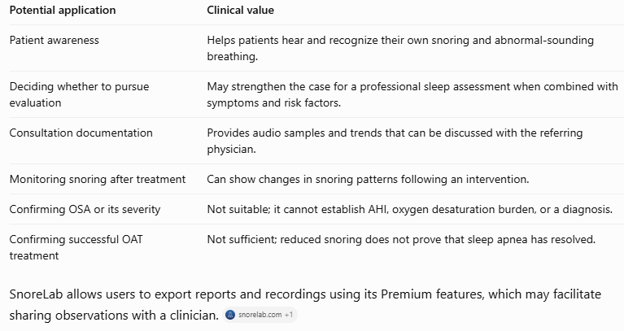
SnoreLab should be viewed as a patient-engagement and preliminary evidence-gathering tool rather than a
Sleep Test that determines who does or does not have OSA.
A practical patient pathway
1. Patient records several nights: snoring, suspected breathing interruptions, symptoms and relevant history
2. Clinician reviews the evidence: consider daytime sleepiness, witnessed apneas, hypertension, risk factors and prior testing
3. Arrange appropriate sleep testing: home sleep apnea testing or in-lab polysomnography, as clinically appropriate
4. Coordinate treatment and objective follow-up: PAP, oral appliance therapy or another appropriate treatment, with follow-up testing when indicated
Caution: A normal-looking app report should never be used to dismiss concerning symptoms, if present, or postpone a sleep evaluation. The American Academy of Sleep Medicine emphasizes that consumer apps and devices cannot independently diagnose OSA or confirm its absence.
5. Recommendation
I would consider recommending SnoreLab to selected RestfulSleep patients who are reluctant to seek testing, unaware of their nighttime breathing, or interested in documenting changes during treatment. The strongest message is not that the app can tell you whether you have sleep apnea or not but rather, it can help you self-detect evidence that makes the invisible nature of nighttime breathing problems more tangible. For a patient who already has diagnosed OSA and is receiving a mandibular advancement device, it may be useful for monitoring changes in snoring—but it cannot establish therapeutic success without appropriate clinical reassessment and, when indicated, objective sleep testing.
Suspect You or a Loved One may have Obstructive Sleep Apnea? We’re here to help!
At RestfulSleep Dr. John L. Bouzis attempts to first fully understand your concerns and needs so we can then provide the perfect solution. Let us know your struggles and we’ll do our best to resolve them.